
For health plans
Fraud and care models fail on provider and eligibility data first.
Health plans are funding fraud, waste & abuse detection, prior authorization automation and member risk models. Most stall on provider identity, adjusted claim lines and retroactive eligibility. In six weeks we grade the systems your use case depends on and tell you exactly what to fix first.
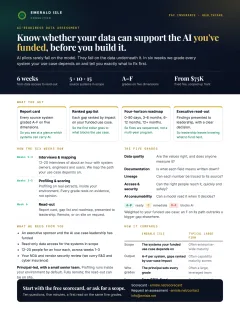
6 weeks from data access · From $75K, fixed fee
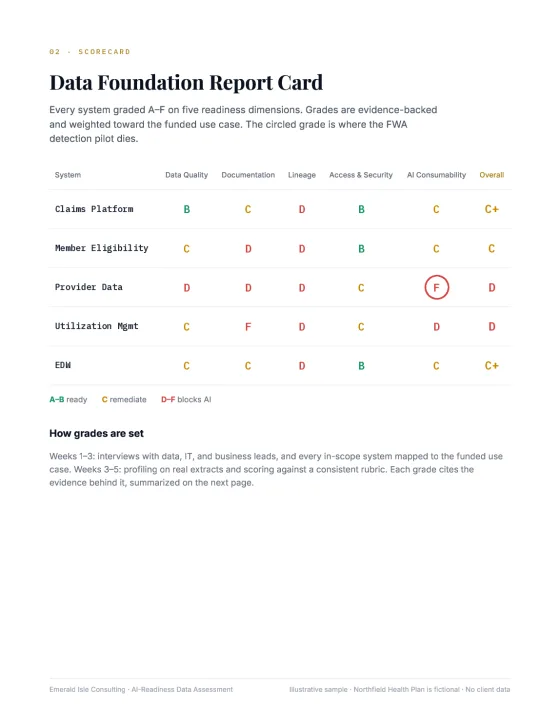
| System | Qual | Docs | Lin | Acc | AI |
|---|---|---|---|---|---|
| Claims Platform | B | C | D | B | C |
| Member Eligibility | C | D | D | B | C |
| Provider Data | D | D | D | C | F |
| Utilization Mgmt | C | F | D | C | D |
| EDW | C | C | D | B | C |
This is where a fraud, waste & abuse model dies.
How It Stalls
Health plans are funding AI. Most pilots stall on the data. Here's how it happens.
The pilot below is illustrative.
Week 6
The demo wins.
Trained on closed investigations, with provider records cleaned by the special investigations unit, the fraud model scores 92% in the steering committee demo. Funding approved.
Go-live
Production data arrives.
Live claims start flowing: clinicians billing under several NPIs and TINs, stale directory addresses, adjustments that overwrite the original claim lines.
Week 14
Accuracy collapses.
The model can't see the provider networks it was trained to find. Accuracy slides to 58%, and investigators drown in false positives.
Week 22
Quietly shelved.
Nobody agrees why it failed, so the next budget cycle funds a different vendor. The same data is waiting for them.
WhyAn assessment finds the gap at week zero, before the budget is spent, not at week fourteen.
Use Cases We Grade Against
Every grade is weighted to the AI you've funded.
WhyA D on a system your use case never touches can wait. An F on the one it depends on can't.
Fraud, waste & abuse detection
FWA models need one identity per provider and consistent specialty codes at the moment a claim is scored.
Prior authorization automation
Authorization decisions need clinical rationale in structured form, and a traceable record of why each decision was made.
Member risk and care management
Risk models need accurate claims and eligibility history, as it stood at each point in time.
Clinical document intelligence
Clinical documents hold PHI; models need them machine-readable, with access tightly controlled.
What We Grade
The systems usually in scope.
Scoped by 5, 10 or 15 source systems: the ones your use case reads from, not the whole estate.
Claims
Lines as originally billed, and every adjustment since
Provider data
One identity per clinician across NPIs and TINs
Eligibility & enrollment
Coverage as of the date of service, not today
Utilization management
Authorization decisions and their rationale
Data warehouse
Where lineage is usually lost
Clinical documents
PHI a model needs to read, under tight access
PHI stays where it is.
Profiling runs inside your environment by default, with minimum-necessary access. We sign your NDA and complete your vendor security review before any data is touched.
See What You'd Get
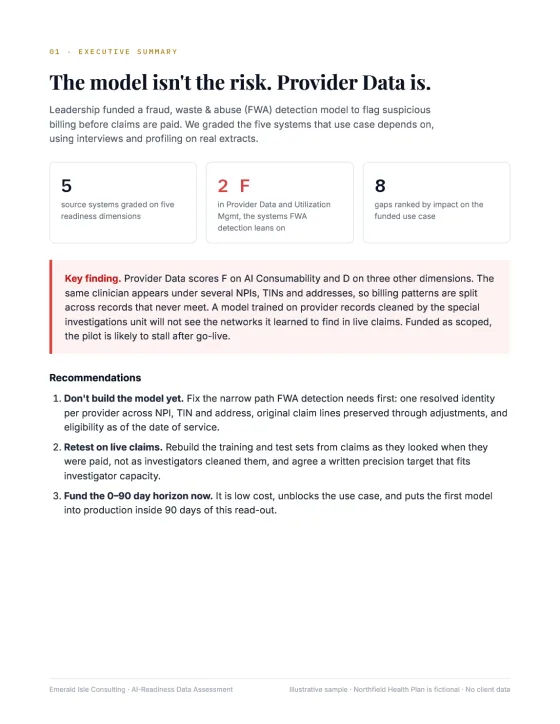
A real read-out, for a fictional health plan.
Field Notes
Worth reading first.
Know before you fund the pilot.
Six weeks, from $75K fixed fee, scoped by the number of systems your use case depends on. A fraction of a typical Big Four assessment.
See exactly what's included in the assessment