
For P&C insurers
Your claims AI is only as good as the data at first notice.
Carriers are funding FNOL triage, claims document intelligence and fraud models. Most stall on intake data, policy history and claim keys that don't line up. In six weeks we grade the systems your use case depends on and tell you exactly what to fix first.
6 weeks from data access · From $75K, fixed fee
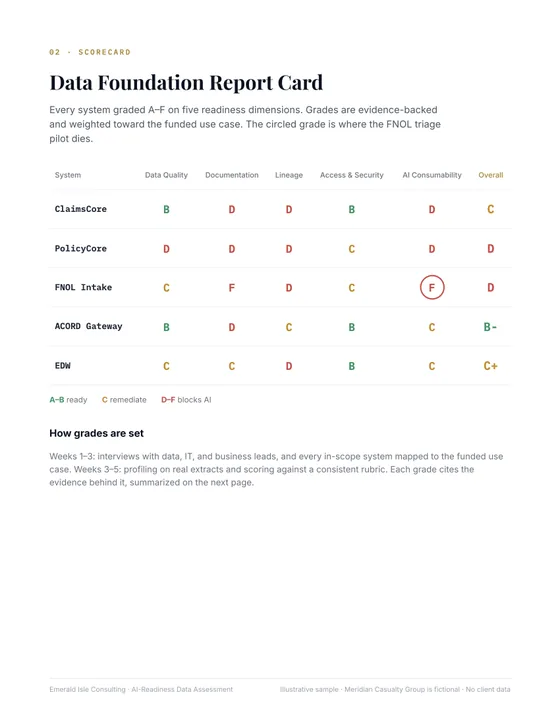
| System | Qual | Docs | Lin | Acc | AI |
|---|---|---|---|---|---|
| ClaimsCore | B | D | D | B | D |
| PolicyCore | D | D | D | C | D |
| FNOL Intake | C | F | D | C | F |
| ACORD Gateway | B | D | C | B | C |
| EDW | C | C | D | B | C |
This is where an FNOL triage pilot dies.
How It Stalls
60% of P&C insurers are stuck in AI pilot mode. Here's how it happens.
Source: Capgemini, The Intelligence Era in P&C, 2026. The pilot below is illustrative.
Week 6
The demo wins.
Trained on a curated set of historical claims, cleaned by hand, the FNOL triage model scores 92% in the steering committee demo. Funding approved.
Go-live
Production data arrives.
Real first notices start flowing: call-center notes typed under pressure, web forms with free-text loss descriptions, scanned PDFs from agents.
Week 14
Accuracy collapses.
The model never sees the structured loss details it was trained on. Accuracy slides to 58%. Adjusters stop trusting the scores and route claims by hand.
Week 22
Quietly shelved.
Nobody agrees why it failed, so the next budget cycle funds a different vendor. The same data is waiting for them.
WhyAn assessment finds the gap at week zero, before the budget is spent, not at week fourteen.
Use Cases We Grade Against
Every grade is weighted to the AI you've funded.
WhyA D on a system your use case never touches can wait. An F on the one it depends on can't.
FNOL triage
Triage runs at first notice, so it depends on what intake fields mean and whether a model can read them at that moment.
Claims document intelligence
Document models need claim files machine-readable, and the values pulled from them checked.
Claims fraud detection
Fraud models compare patterns across claims; inconsistent or untraceable data turns into false alarms and audit questions.
Underwriting knowledge search
Search is only as good as what the documents mean, and who is allowed to see them.
What We Grade
The systems usually in scope.
Scoped by 5, 10 or 15 source systems: the ones your use case reads from, not the whole estate.
FNOL intake
Where triage decides, often on free text and scanned PDFs
Claims system
The labels a model learns from, and how they change
Policy admin
Coverage as it stood on the date of loss
Billing
Payment history that feeds fraud and retention models
Data warehouse
Where lineage is usually lost
Document stores
Adjuster notes and correspondence a model can't yet read
Regulators will ask where every input came from.
The NAIC Model Bulletin expects insurers to govern the data behind their AI systems. The lineage and documentation grades tell you whether you can answer today.
See What You'd Get
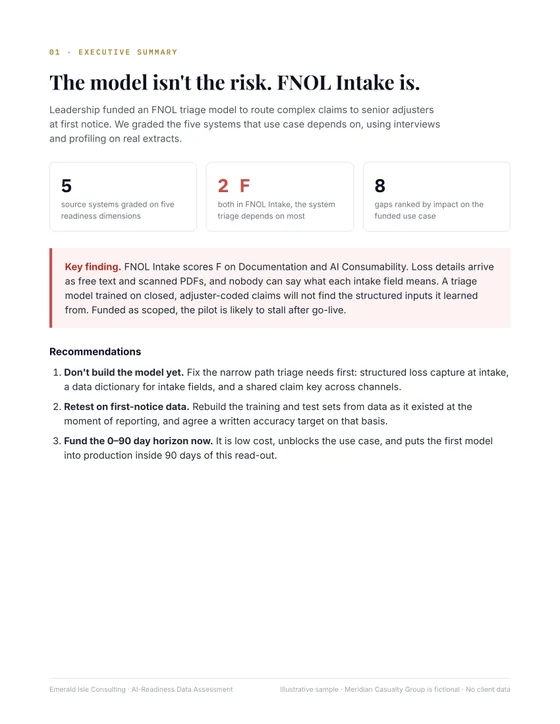
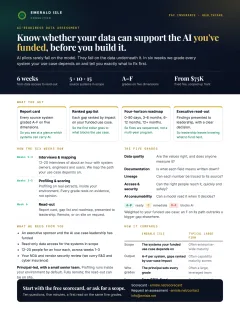
A real read-out, for a fictional P&C carrier.
Field Notes
Worth reading first.
Know before you fund the pilot.
Six weeks, from $75K fixed fee, scoped by the number of systems your use case depends on. A fraction of a typical Big Four assessment.
See exactly what's included in the assessment