Fix the narrow path, not the whole data estate
Enterprise data programs try to fix everything and rarely finish. AI programs that ship fix only what their first use case depends on, then widen from there.
Emerald Isle Consulting · October 2026 · 5 min read
Once a data assessment shows the gaps, the natural reaction is to fix all of them. Commission a data-quality program. Launch a governance initiative. Modernize the warehouse. Each is reasonable on its own, and together they become a multi-year program that has to be finished before any AI is allowed to ship.
Those programs rarely finish. Budgets get reallocated, sponsors move on, and the AI use case that justified the work is still waiting at the end of it.
The path a use case actually walks
Every AI use case depends on a narrow slice of your data estate: a handful of systems, a few dozen fields, a couple of joins. A first-notice triage model needs intake data, current coverage and a shared claim key. A fraud model needs a resolved identity for each provider, claim lines as originally billed, and eligibility as of the date of service.
That slice is the narrow path. Fix it, and the use case can ship. Leave it broken, and no amount of work elsewhere will save the pilot.
| Fix the whole estate | Fix the narrow path | |
|---|---|---|
| Scope | Every system, every gap | Only what the use case touches |
| First result | When the program finishes | Within the first 90 days |
| Budget | Spread across everything | Spent where it unblocks AI |
| Sponsor | Hard to keep for years | Sees progress quarter by quarter |
| Risk | Use case waits for the program | Program follows the use case |
How to find the narrow path
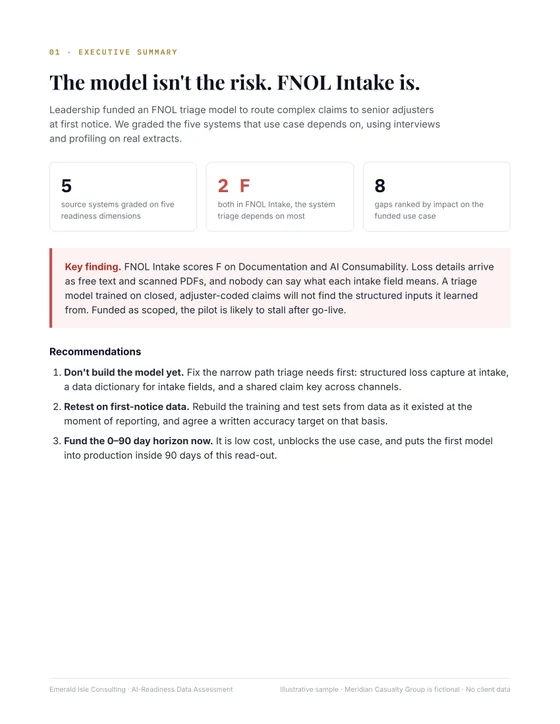
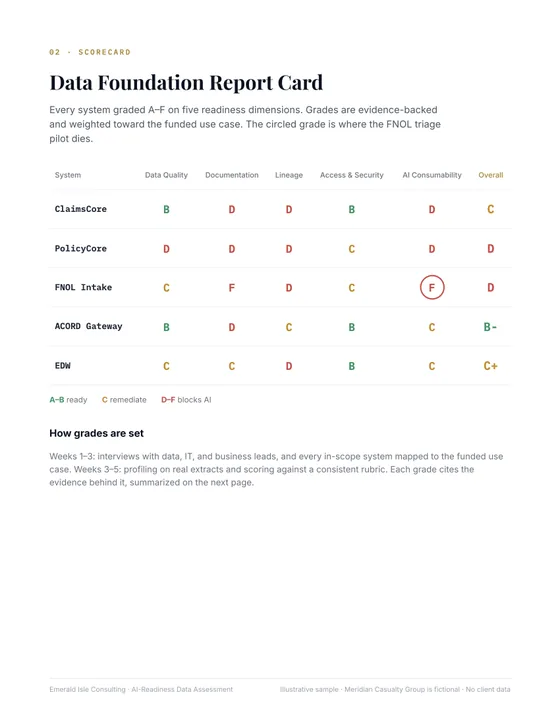
Start from the use case, not the estate. List every system the use case reads from, grade each one, then rank every gap by its impact on that use case, not by how bad it looks in the abstract. A gap that blocks the funded use case ranks above a bigger gap that doesn't.
In practice, most of the ranked list sorts into three groups: gaps that block the use case outright, gaps that degrade its accuracy, and gaps that create audit risk. Blockers come first, even when they're small.
A small gap on the path beats a large gap off it, every time.
A roadmap in four horizons
Fixing the narrow path doesn't mean ignoring the rest. It means sequencing it, so the first use case funds the case for the next. We lay roadmaps out in four horizons:
- 01
0–90 days: quick wins. Adopt a glossary and name data stewards, fix the blockers on the narrow path, and scope the first use case with a written accuracy target. This is what gets the first model into production.
- 02
Months 3–6: fix what blocks the use case. Golden-record pilots, documents made machine-readable, shared keys across channels: the heavier fixes the use case still depends on.
- 03
Months 6–12: rebuild the plumbing. Automated lineage, pipeline rebuilds and system integration, so the second and third use cases don't start from zero.
- 04
12 months and beyond: hand over. Same-day data for the business, playbooks handed to your own team, and capacity that scales with the AI program.
Why this works
The narrow path changes the economics. Instead of asking leadership to fund a data program and wait, you ask them to fund the fixes one use case needs, and you show a model in production within a quarter or two. That result is what earns the budget for the next horizon.
The rest of the estate still gets fixed, in the order your AI program needs it, by your own team or by partners, with a roadmap that says what each piece unblocks.