
Is your data ready for the AI you were promised?
A six-week, fixed-fee assessment of the systems your AI use cases depend on. Every system graded, every gap ranked, and a sequenced roadmap to your first use case in production. Built for P&C insurers and healthcare organizations.
When to Call Us
Three signs it's time.
Sign 01
"The board wants AI, but our data isn't ready."
An AI mandate with a clock
The board or CEO has set expectations, and someone owns a deadline they aren't sure they can hit.
Sign 02
"We tried a vendor POC and quietly shelved it."
A pilot that stalled or died
A vendor proof of concept or an internal build never made it to production, and nobody agrees why.
Sign 03
"Nobody trusts our claims data."
A data estate nobody trusts
Claims data, policy records, or lineage questions keep surfacing in every planning meeting.
How It Works
Six weeks from data access.
We need interviews with the people who know your systems and read access to extracts from the systems in scope. The clock starts when data access is in place.
Interviews & mapping
- Interviews with data, IT, and business leads
- Every in-scope source system mapped
- The AI use cases leadership has funded, documented
WhySo we assess only the systems your use case touches, not your whole data estate.
Profiling & scoring
- Profiling on real extracts, not just interviews
- Every system graded A–F on five dimensions
- Gaps ranked by impact on the funded use cases
WhyInterviews tell you what people believe about the data. Profiling shows what it actually is.
Leadership read-out
- Findings presented to leadership
- Roadmap in four horizons
- First use case scoped for 90 days
WhySo leadership can make the call with evidence, not opinions.
Why these five dimensions
Each one is a different way a pilot fails in production. We grade every system on all five.
Data Quality
Models learn whatever errors the data contains, at scale.
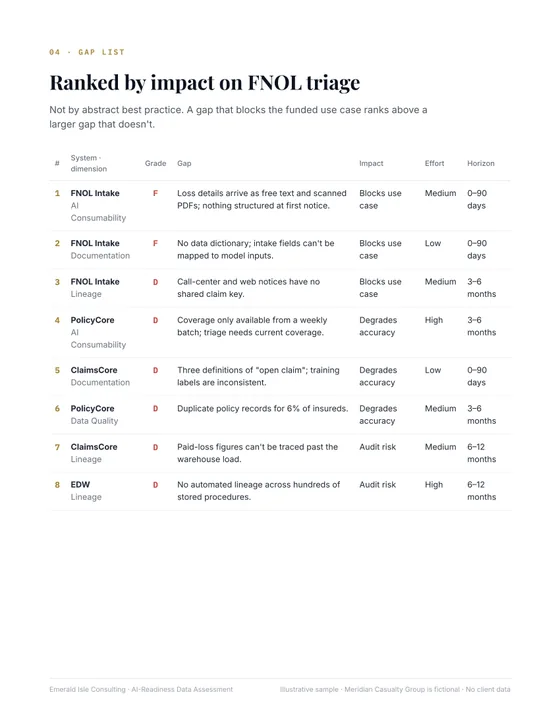
Duplicate policy records for 6% of insureds since the last platform migration.
Documentation
If no one can say what a field means, no one can map it to a model.
No data dictionary. Field meanings are known only to the original vendor team.
Lineage
Regulators and auditors will ask where every input came from.
Paid-loss figures in the board pack can't be traced past the warehouse load.
Access & Security
AI teams that wait months for data never get past the pilot.
Access granted request by request through one DBA; average wait three weeks.
AI Consumability
A model can only use data it can read at the moment it decides.
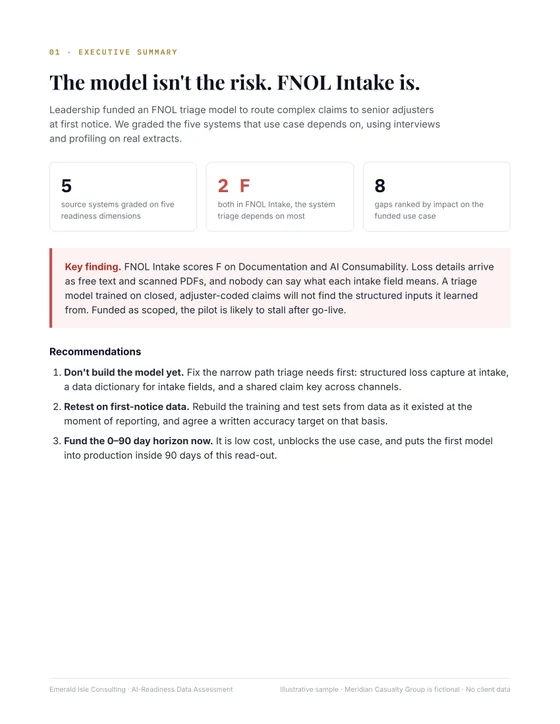
Loss descriptions arrive as free text and scanned PDFs. A triage model has nothing structured to read at first notice.
Examples from the sample read-out for Meridian Casualty Group (fictional).
What We Provide
The scorecard, not slideware.
Sample Deliverable
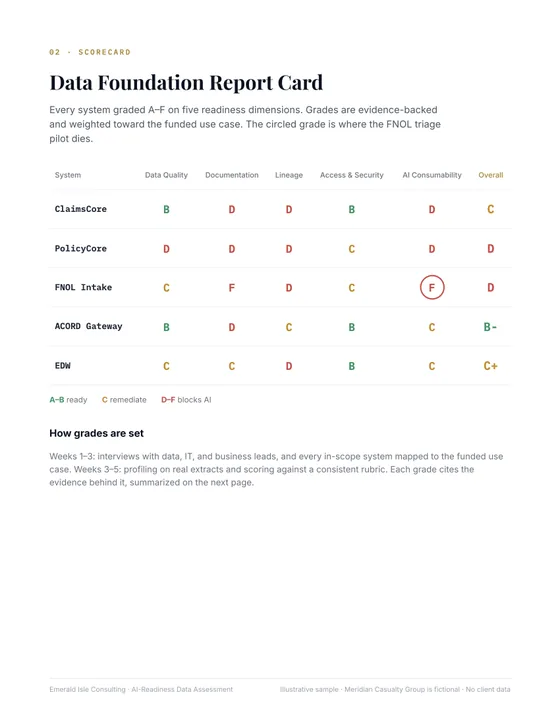
What the scorecard looks like.
An excerpt from a sample assessment of a fictional P&C carrier. No client data.
| System | Data Quality | Documentation | Lineage | Access & Security | AI Consumability | Overall |
|---|---|---|---|---|---|---|
| ClaimsCore | B | D | D | B | D | C |
| PolicyCore | D | D | D | C | D | D |
| FNOL Intake | C | F | D | C | F | D |
| ACORD Gateway | B | D | C | B | C | B- |
| EDW | C | C | D | B | C | C+ |
The circled F is where an FNOL triage pilot dies. Every grade is evidence-backed: interviews plus profiling on real extracts, tied to the use cases leadership funded.
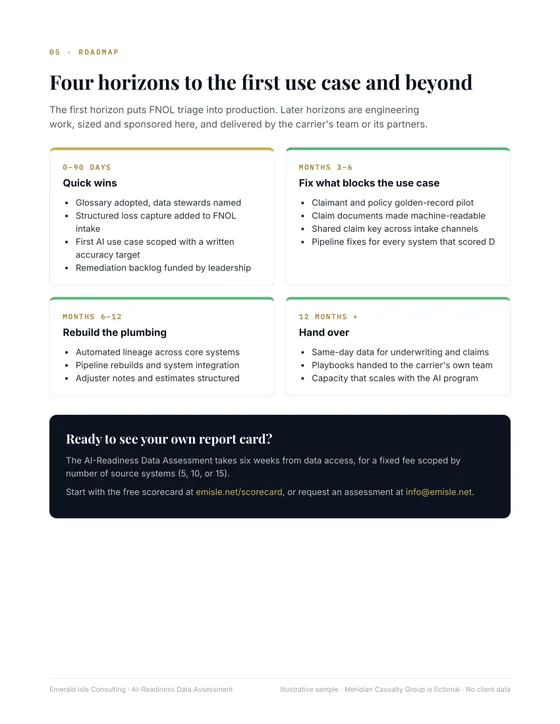
The roadmap: four horizons.
0–90 days
Quick wins
- Glossary adopted, data stewards named
- First AI use case scoped with a written accuracy target
- Remediation backlog funded by leadership
WhyUnblock the first use case fast, and show progress early.
Months 3–6
Fix what blocks the use case
- Claimant and policy golden-record pilot
- Claim documents made machine-readable
- Pipeline fixes for every system that scored D
WhyRemove the specific gaps that would stall the use case in production.
Months 6–12
Rebuild the plumbing
- Automated lineage across core systems
- Pipeline rebuilds and system integration
- Adjuster notes and estimates structured
WhySo the second and third use cases don't start from zero.
12 months +
Hand over
- Same-day data for underwriting and claims
- Playbooks handed to your own team
- Capacity that scales with the AI program
WhySo your team owns it, and you're not dependent on us.
5 · 10 · 15
source systems
Fixed fee, scoped by system count
Agreed before we start, with no hourly billing. A fraction of the cost of one stalled pilot. Early-client pricing holds for 2026 engagements.
1
architect, start to finish
Senior-led
The architect who scopes your assessment runs the interviews, does the profiling, and presents the read-out.
0
lock-in
Yours to act on
The roadmap belongs to you. Execute it with your own team, your existing partners, or with us and our partners.
After the Read-out
A six-week answer, then a sequenced path.
If you want us to keep going, two engagements follow. From data access to first use case in production: about 19 weeks.
Applied AI Build
8–12 weeksOne narrow use case, built to a written accuracy target, inside the 90 days after the read-out.
AI Governance
4–8 weeks, alongside the buildThe controls that let a model go live in a regulated business.
Before You Sign
Questions security and procurement ask.
Straight answers on data access, your team's time, cost and independence.
Data access and security
What data do you need?
Read access to extracts from each in-scope system, plus the documentation you already have: data dictionaries, architecture diagrams, interface specs. We profile samples; full production loads aren't required.
Does our data leave our environment?
Only if you choose. By default, profiling runs inside your environment, under your access controls. Where that isn't practical, extracts move over a secure transfer method you approve, and are deleted at the end of the engagement.
Will you sign our NDA and go through vendor security review?
Yes. We sign your NDA and complete your vendor security review before data access, and plan the start date around it. We carry professional liability (E&O) and cyber liability insurance.
What about claimant, member and patient data?
Profiling measures fields and tables: completeness, validity, duplicates, and how records link across systems. Nobody reviews individual claims or patient cases. Where sensitive fields such as PHI are in scope, they can be masked before profiling, or profiled inside your environment so they never leave it.
What about our regulators?
Regulators ask where reported figures and model inputs come from, who owns the data, and who can reach it. The assessment grades exactly that, system by system, and shows where the answers break down. Closing those gaps is roadmap work, and governance support, including deployment patterns aligned with the NAIC Model Bulletin for insurers, is available as a follow-on.
Time, cost and scope
How long does it take?
Six weeks from data access: weeks 1–3 interviews and mapping, weeks 3–5 profiling and scoring, week 6 the leadership read-out. The clock starts when access is in place, not at signature.
How much of our team's time does it need?
A project lead to schedule interviews and approve access; 12 to 20 interviews of about an hour each in weeks 1–3, with the data, IT and business people who run the in-scope systems; and your sponsor at the read-out.
What does it cost?
A fixed fee, scoped by the number of source systems: 5, 10 or 15. You know the price before we start, and there's no hourly billing. Early-client pricing holds for 2026 engagements.
What if we have more than 15 systems?
We scope to the systems your funded AI use case actually depends on, which is usually fewer than people expect. Larger estates can be assessed in phases.
Is it remote or on-site?
Remote. Interviews, profiling and the read-out run over video and the access you approve. If you'd like us in the room for the read-out, we can arrange it.
Do you work with healthcare organizations as well as insurers?
Yes. Health plans and providers are graded on the same five dimensions, against use cases such as fraud, waste and abuse detection. Switch this site to Healthcare to see a health plan's sample read-out.
Outcomes and independence
What do we get at the end?
A scorecard grading every in-scope system A–F on five dimensions, a gap list ranked by impact on your funded use case, a roadmap in four horizons with the first use case scoped for 90 days, and a leadership read-out.
Do we have to hire you to implement it?
No. The roadmap is yours to act on, with or without us. Your own team or existing partners can take it on. If you want us, we deliver the first AI use case (Applied AI Build) and the governance work; larger platform engineering is delivered with our partners.
Are your recommendations vendor-neutral?
Yes. The roadmap points to what your use case needs, not to a particular product.
What if the assessment says we're not ready?
That's the point of doing it first. A graded answer in six weeks costs a fraction of a pilot that stalls after go-live, and the roadmap says exactly what to fix first.
Six weeks from now, you could have the answer.
Tell us how many source systems are in play and which AI use cases leadership has funded, and we'll send a scope and a fixed fee.